September 26, 2023
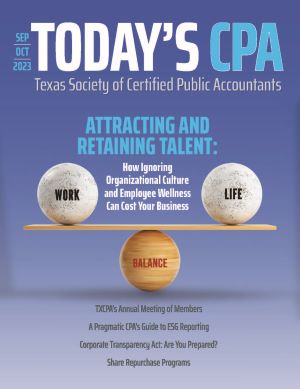
Pragmatic CPA’s Guide to ESG Reporting




By Michael Kraten, Ph.D., CPA, and Mohan Kuruvilla, Ph.D., CPA
The May/June 2023 issue of Today’s CPA includes an article entitled “Is GHG Scope 3 Emissions Reporting a Step Too Early or Too Far?” On the one hand, the author reasonably justifies his decision to “beg the question” by describing the current unresolved debates over the costs and benefits of requiring such disclosures. Until such debates are resolved, companies must decide for themselves if the benefits of voluntary Environmental, Social and Governance (ESG) reporting exceed the costs.
Some companies may assume a traditional “don’t disclose anything unless required to do so” stance. Increasingly, though, such a stance is out of step with the modern economy. ESG reporting systems now occupy a prominent position in our global financial system. Trillions of dollars are invested in organizations that publish positive ESG performance metrics.
CPAs differ widely about the wisdom of placing significant reliance on ESG measurements. Most, however, agree on a simple fact: the sector has grown to a size that can no longer be ignored.
So what do practical-minded CPAs need to know about the field? This article reviews the history, the standard-setting entities, the report categories, and the laws and regulations that impact the accounting profession. For illustrative purposes, it then reviews the ESG reporting strategies of four publicly traded energy companies.
History of the Sector
Many business historians trace the origins of ESG reporting to the founding of the U.S. Environmental Protection Agency in the 1970s. Others mark its emergence with the issuance of Social and Environmental Assessment Reports (SEARs) by Ben & Jerry’s during the 1980s.
The sector entered the accounting mainstream in the 1990s with the conceptual development of the Triple Bottom Line (TBL), featuring the principle that stakeholders are focused on more than just the “bottom line” of the traditional income statement. Advocates of TBL lobbied for the disclosure of environmental, social and economic metrics that address long-term sustainability considerations.
Governance concerns during the Enron era added a fourth dimension to the three core TBL metrics. The subsequent integration of social and economic dimensions into a single socio-economic category completed the evolution of the TBL paradigm into an ESG model.
Integrated Reports briefly appeared in mainstream accounting policy discussions 10 years ago; they were designed as annual financial reports that were expanded to accommodate non-financial ESG data. Given the bloated nature of such reports, the accounting profession pivoted to the current system of multiple annual reports, with one or more ESG report(s) published “side by side” with separate financial reports.
Standard-Setting Entities
Whereas the Financial Accounting Standards Board and the International Accounting Standards Board publish financial accounting standards, a number of nonprofit entities publish ESG accounting standards. Some of these entities issue comprehensive sets of standards, while others focus on relatively narrow specialty topics.
The Sustainability Accounting Standards Board (SASB), for instance, promulgates comprehensive standards on an industry-by-industry basis. The Global Reporting Initiative (GRI), meanwhile, defines its standards on a business function-by-function basis. The United Nations defines indicators from a public interest perspective, metrics that are categorized within 17 Sustainable Development Goals (SDGs).
Specialty organizations, meanwhile, publish standards that focus on single topics. Some, like the Taskforce on Climate-related Financial Disclosures (TCFD), emphasize specific public concerns. Others, like the International Petroleum Industry Environmental Conservation Association (IPIECA), are industry trade associations. And others, like the Global Impact Investing Networking (GIIN), represent specific capital investment sectors or global interest groups.
Most CPAs with interests in ESG reporting become familiar with the SASB, GRI and SDG standards. If necessitated by their fields of practice, they also acquire a passing knowledge of the standards of one or two specialty entities.
The sector, though, is inexorably becoming more standardized on a global basis. In 2021, for instance, the IFRS Foundation announced the creation of the International Sustainability Standards Board (ISSB). Standards S1 General Requirements and S2 Climate-related Disclosures were issued in June 2023, although individual jurisdictions maintain the authority to determine whether the standards will remain optional or will become mandatory.
In other words, the two standards are not necessarily mandatory in jurisdictions that require IFRS adoption for financial reporting purposes. Nevertheless, the establishment of global standards by an IFRS Foundation entity represented a major step forward in the standardization of sustainability disclosures.
Report Categories
Impressively, Ben & Jerry’s has continued to publish annual SEAR Reports since the 1980s. Instead of following their pioneering approach, though, most firms now disclose data in a number of newer formats.
The most common ESG reports present data in accordance with selected SASB, GRI, SDG and specialty standards. Exxon Mobil’s report, for instance, refers to the IPIECA, GRI and SDG standards, while Valero’s report utilizes the SASB and TCFD standards.
Many companies also publish assurance letters that they receive from public accounting or non-accounting firms. NRG Energy, for example, publishes a Greenhouse Gas Emissions Report that is issued by KPMG; it refers to a “limited assurance” basis in accordance with “attestation standards established by the American Institute of Certified Public Accountants.” However, ExxonMobil and Valero contract with an entity called Lloyd’s Register Quality Assurance Limited to perform attestation procedures. This is an area where CPAs in public practice can develop the in-house skill sets to provide assurance services for such reports.
Laws and Regulations
All government jurisdictions possess the right to issue regulations related to ESG considerations. When businesses develop or join supply chains that extend beyond jurisdictional borders, they often find it necessary to comply with multiple (and, at times, conflicting) legal requirements.
The European Union (EU), for instance, has extended its supply chain regulations to encompass the concept of the Value Chain. Just as Value Added Tax laws adopt relatively broad approaches to identifying organizations that are subject to taxation, Value Chain disclosure laws impact a similarly broad array of organizations that must report ESG metrics.
One example of such global regulations is the EU’s Corporate Sustainability Reporting Directive (CSRD). This directive became effective in January 2023; it extends the current reporting requirements of the EU’s Non-Financial Reporting Directive (NFRD). The first of approximately 50,000 large companies to be covered by the CSRD will need to comply for the first time in 2024, mandating ESG reports to be published for the first time in 2025.
Corporations based outside of the EU, but with a significant presence within the bloc, may need to comply with the disclosure requirements. Thus, American companies that do business in the EU may need to measure and report ESG metrics in accordance with EU policies.
In the United States, the Securities and Exchange Commission (SEC) has issued draft regulations for publicly traded companies regarding the mandatory disclosure of carbon emissions. These regulations are expected to be issued in final format later this year.
Energy Company Reports
For illustrative purposes, this section reviews the sustainability reports of Chesapeake Energy Corporation (chk.com), Diamondback Energy (diamondbackenergy.com), Occidental Petroleum (oxy.com) and Pioneer Natural Resources (pxd.com). All are publicly traded corporations, with three headquartered in Texas and one in Oklahoma. All are engaged in oil production in the United States.
Chesapeake. Chesapeake’s home page features a “Sustainability” link with six sustainability menus that are dedicated to the primary ESG sections (Environment, Social and Governance) and to supplemental sections (Climate, Safety and Approach).
The six menus encompass a total of 28 sub-menus. The central focus, though, is a 74-page 2022 Sustainability Report with Data Tables and Content Indices. Chesapeake utilizes the standards and metrics of SASB and GRI, along with several industry trade associations.
Chesapeake also publishes an assurance opinion on certain environmental metrics, a letter that was issued by a consulting firm named Spirit Environmental. There are no other assurance letters in the report.
Diamondback. The “Sustainability” link on Diamondback’s home page leads to a single web page with links to three formal reports. The primary document is a 48-page 2022 Corporate Sustainability Report with an Appendix of data tables. Diamondback utilizes the standards and metrics of SASB, while presenting a limited assurance opinion letter by Grant Thornton on certain metrics.
The two secondary documents are, respectively, a 17-page document that discloses metrics and information about water security and a 46-page document with disclosures regarding climate change. The reports comply with the dictates of the Carbon Disclosure Project (CDP), a specialty nonprofit entity that defines environmental standards and metrics.
Occidental. Occidental’s “Sustainability” link leads to a broad array of disclosures that are presented under each Triple Bottom Line category (labeled Planet, People and Prosperity) and under the Governance category. Eleven PDF documents are available for download, including a Sustainability Report, an Annual ESG Performance Indicators document and an Independent Assurance Statement document.
The Sustainability Report is a 67-page PDF document that is “informed by” the SASB standards and the guidelines of several other industry trade associations and global interest groups. The report also refers to the United Nations SDGs, while containing a limited assurance letter by a consulting firm called Environmental Resources Management.
Pioneer. Pioneer’s “Sustainability” link on its home page features two sub-links: Safety and Environmental. Its web pages contain links to a 2022 Sustainability Report, as well as documents entitled Performance Data Table, Sustainability Content Index, Methodologies and Definitions, Climate Risk Report, and TCFD Index.
The 75-page Sustainability Report is a PDF document that covers a full array of ESG criteria, including Governance and Social Value. It concludes with a four-page section entitled Our Reporting Approach, a section that explicitly cites the SASB, GRI, SDG, and TCFD guidance, along with the standards of other trade association and global interest groups.
As is true of the Occidental report, there is a limited assurance letter by the consultancy Environmental Resources Management.
Summary Table
Comparative Observations. Chesapeake, Diamondback, Occidental and Pioneer have each chosen to present a different set of standards, metrics and presentation options. All, however, have similarly decided to present detailed and voluminous sustainability reports that can be easily accessed by clicking on a Sustainability menu link on each company’s home page. In addition, all have chosen to rely on the standards and metrics of the SASB.
To varying extents, three out of four also rely on the guidance of the GRI, SDG and TCFD. In addition, all four utilize the frameworks of various industry trade associations and global interest groups.
The dominant presence of consultancy assurance letters in this set of four sustainability reports may be attributable to a small sample size. However, given the professional environmental credentials of these consulting firms, and given our society’s current preoccupation with climate change, their dominance may also be attributable to the emphasis on technical carbon emission data within the ESG reports of oil and gas firms.
The Public Accounting Profession
Many service units of multi-disciplinary public accounting firms already address ESG considerations. For instance, financial statement audit engagements must assess environmental lawsuit risks while evaluating the adequacy of contingent liability accruals.
Income taxation planning engagements must consider the availability of carbon tax credits. Financial feasibility consulting engagements must address the risks of outsourcing manufacturing processes to nations with weak human labor standards.
CPAs who grapple with such issues, but who are not familiar with the ESG standards, reports and regulations that are defining these fields, may not be fully prepared to meet their current responsibilities to their clients.
The information in this article can help them identify appropriate guidance to bring themselves up to speed with such content. For instance, CPAs may choose to identify three to five standard setting entities, one to three competitor organizations, and one to three legal authorities to follow for ESG reporting guidance. By focusing on the guidance of such organizations, CPAs can empower themselves to develop pragmatic recommendations regarding ESG reporting.
Furthermore, because the issue of climate change represents a dominant concern among government regulators, corporations and investors, CPAs may wish to become particularly proficient at carbon emission data collection, reporting and assurance work. To achieve such proficiency, CPAs should:
- Become familiar with the carbon emission standards of the universal standard-setting entities, such as GRI 305 Emissions, TCFD Metrics and Targets – Recommended Disclosures, and SDG 13 Climate Action;
- Become familiar with the climate-specific emission guidance of relevant nonprofit groups like the Carbon Disclosure Project (CDP) and the World Business Council for Sustainable Development (WBCSD);
- Become familiar with the most recent developments in the sector, such as the ISSB’s new standards and the EU’s new CSRD directive;
- Develop professional relationships with environmental consulting organizations that can serve as external specialists for limited assurance engagements involving carbon emission data.